This winter I took a break. I decided to stop blogging and reading blogs a bit to keep my sanity. There are so many blogs out there that I've been reading or stopping by here and there that have really started to rub me the wrong way. Ones that tout that their way of life as the only way to live or that this type of food or way of raising food is wrong on so many levels. If I were to start blasting certain groups of people, I'm sure I would get lots of nasty responses saying I was wrong or that I'm being mean. I realize we are all entitled to our own opinions, but it still doesn't make it right to speak against a certain group of people when they are doing their best to provide for others.
I come from a farming background. Not a corporate farm, but a large family farm. At least it's fairly large for the area I live in. Some people would feel it is tiny compared to farms in other states, but in our little slice of the world, I think it's a good sized operation. It's a conventional farm. GASP! I said it, conventional. We grow wheat, soybeans, milo, sesame, and sometimes corn-although, we don't have the moisture to grow corn successfully. I know there are a lot of people who only feel organic farms and small locally grown produce farms are the way to grow food. Well, guess what. The world would starve without conventional farmers. Self-sustainable farms can't feed the world, let alone all the people in their own state. It takes ALL types of farms to feed the world. Locally grown produce is wonderful! I applaud those who take on that task and succeed, but we have to think larger scale here. There are a lot of people who have no desire to grow their own food. That's ok. They may provide a service that those of us who do grow food may need. You are either reading this post on a computer or phone. Who makes those? Certainly not me and possibly not you either, but there are people out there working their jobs and letting the farmers grow their food, while they make the farmer's phone, computer and other technology. It's a win-win situation in most cases. (There are always exceptions...)
Ok, I think I'm done with my soapbox, but it may get revisited. On to what's up on our farm!
We are starting up a new season on our farm. It's been a rough start though. We have 16 acres of wheat planted by our house and there hasn't been much moisture this winter. Yes, we had about 12 inches of snow this winter, but when you melt that down, you don't get much water. Since the snow, we've had .2 inches of rain-that was just this past week. Well, that isn't enough to get the wheat up and going strong enough to produce a good crop. On my way to work this morning I was noticing that the wheat is heading out. Yikes! Our field is only about 6 inches tall. Not tall enough to already be heading out! We have brown patches in the middle of the field that will probably not even produce a head. Hopefully we'll have enough to harvest this summer. It could be a sad harvest this year. We may try to double crop some milo, but that typically is a bust too.
The garden is in for the most part, but the wind is wreaking havoc on my planting schedule. I have a few heads of lettuce that I transplanted in one row, but I'm unable to get out and plant lettuce seeds for fear they'd never make it into the row and would blow into the tree row. I'm working on mulching my rows this year with wheat straw. We traded 3 bales of prairie hay for 6 bales of wheat straw with a friend of ours. This straw should help keep weeds down to a minimum and the straw breaking down in the soil should help amend it and create a good base for the future. I used some straw last year in one part of the garden and I can already see it starting to work it's magic in the soil.
Our 4-H lambs are finally here. We are going to keep the ewes after the fair this year and hopefully breed them back and start our own herd. I don't know how this will work, but we are going to try. It should be a little easier than dealing with cattle, but it's an animal, so that thought will probably be thrown out the door when we starting having issues, and I know we will have issues. :)
Now I'm off to a high school track meet. I'll try not to blow away in the 30+mph winds we are having today..... My son runs the 110 m high hurdles and of course the wind is out of the west today, so they will be running INTO the wind. Every other day we've had meets, it's been out of the north or south and of course they were running into the wind those days too. But today, the track runs east and west. Most days, that would be ideal, because you would have a cross wind that is a little easier to deal with. Nope, no such luck. Hope he doesn't crash and burn!
Monday, April 28, 2014

Tuesday, February 11, 2014
Farming
I really enjoy surfing the web and seeing what other people are talking about when it comes to sustainable living and homesteading. I'm striving to be more self-sufficient, but I know I'll never be 100%. I'm ok with that. I've been spoiled with conveniences that I don't really wish to give up. I guess if push came to shove and I had to give certain things up, I'd adapt, but I'd rather not. That's probably not the best attitude, but that's where I am at this point in my life.
One thing I am having a hard time understanding in the homesteading community is their idea of Big Ag. What do you consider Big Ag? Do you consider anything over a couple hundred acres to be too big and a corporate farm? My thought may completely differ from yours on this.
I grew up on a family farm. I am the 5th generation to be trying my hand at farming. My husband and I only own 48 acres. Around our area, that is not even a farm. It's a patch of land that you play with. We have 16 acres that is crop ground, 22 acres that is pasture/hay ground and the rest is the homestead. Definitely not enough to live off of. My parents farm the land my Great-Great Grandparents first homesteaded. My mom jokes that the reason we are where we are is that this is where the wagon wheel fell off. It's an area of red dirt clay with thin topsoil. We get envious of black dirt farmers! :)
Over the years my parents have acquired more land, either through buying it or renting it. They now farm 3000+ acres of crop ground and pasture. Is that considered Big Ag to some? Maybe, but to me, it's not. It's still a family farm. It supports my parents and pays the bills. It allows them a few nice things, but don't they deserve it after years of struggling to pay bills, raising three kids and caring for aging parents that are now gone? They have had to sacrifice many things during the lean years, just like a lot of the other farmers in this great nation.
They employ 1 hired hand and throughout the summer some friends come out to help out during harvest. Both my brothers and I were the farm hands when we were still young and living at home. I learned a lot over those summers.
My dad has worked very hard learning the tricks of the trade and trying to farm more responsibly. He has even abandoned the conventional thought of turning over the soil each season. He is now a no-till farmer and has had huge successes with it. He's been featured in a farm magazine for this way of farming. (Sorry, can't think of the magazine name at this moment.)
No-till farming is a way of farming that leaves the residue of the previous crop in the field-stubble, stalks, dropped grain, chaff, etc. This residue sits on top of the soil instead of being turned under. That helps nutrients stay put in the soil and not be moved around constantly. It encourages good bacteria to do their job and break down the leftover material. It also promotes earthworms to stay in the field and aerate the soil. When a farmer tills the soil it disrupts their environment and they leave. If there are not worms in the soil, there are no worm tunnels and water can not filter through quickly. Our little 16 acres is a prime example of this practice. When we moved onto our land, the previous farmer plowed after each crop. There were huge ridges of soil along the edges of the field and where he would make his turns and a very large drowned out spot where water would collect, but couldn't drain. We spent some time working the ground that first year to try and even out things. When you no-till, you may still have to use a chisel or disc to work up small areas that get ruts from harvest, but it's not the whole field each year, just spots.
After about 4 years of crops (and a few crop wanna be's) we are finally seeing progress. We've had some pretty big rains that would flood the front yard, but once things drained into the ditch and could drain through the soil, the drowned spots were much smaller. The residue left on the field each year after the harvest acts as a natural mulch too, keeping the soil much cooler and keeping moisture where it belongs. The soil also stays put better with no-till farming. When you till the ground and it gets wet, it likes to create a crust that seals and will not let water penetrate. This then causes the water to wash over the soil and carry it away to the ditch. Well, there just went that little bit of topsoil that you started with and also any nutrients that might be beneficial for a new crop. Wind is not able to pick up as much of the loose soil either, because it's covered.
Now, here comes the part that most self-sufficient homesteaders will cringe about. We do use chemicals to control weeds and fertilizers to help promote healthy plants. We use much less of both now that no-till is being used. The residue that is in the field acts as a mulch to keep fewer weeds from growing. There are still some that come up, but less herbicide is used to kill them off. When you are trying to control weeds on a 160 acre field, you just can't go through and hand pick them. The farmer would never have a crop if that were the case. Some people paint a picture that the plants are drenched with chemical. When I hear that, my mind shows me a picture of a plant, standing there and the liquid is pouring down it, dripping off the leaves. It's practically the opposite. The chemical is mixed with water and a fine mist is sprayed. Very little chemical is actually being used. The tanks on the sprayers are huge and most of that is occupied by water. I don't have application rates, as each one will differ.
I'm not a professional at any of this. My dad is the one that does this for a living. He's been around this for years and has not had many health issues. He's going to be 69 years old this year and is one of the healthiest men I know. He has had his share of colds, flu, and other inconvenient illnesses and injuries, but nothing serious. I feel blaming agriculture for everyone's cancer, reproductive issues, learning disabilities and other health problems is wrong. I've seen extremely health conscience people get sick with cancer. It's not fair to make one group out to be the cause. We all need to help keep our earth clean and be better stewards of the land. Ask a farmer and they will tell you that the land is what keeps them in business. If they destroy it, they will destroy their livelihood. That's not what they are trying to do.
This is my opinion on farming. If you don't agree with it, that's fine.
I respect your opinion. Please respect mine.
One thing I am having a hard time understanding in the homesteading community is their idea of Big Ag. What do you consider Big Ag? Do you consider anything over a couple hundred acres to be too big and a corporate farm? My thought may completely differ from yours on this.
I grew up on a family farm. I am the 5th generation to be trying my hand at farming. My husband and I only own 48 acres. Around our area, that is not even a farm. It's a patch of land that you play with. We have 16 acres that is crop ground, 22 acres that is pasture/hay ground and the rest is the homestead. Definitely not enough to live off of. My parents farm the land my Great-Great Grandparents first homesteaded. My mom jokes that the reason we are where we are is that this is where the wagon wheel fell off. It's an area of red dirt clay with thin topsoil. We get envious of black dirt farmers! :)
Over the years my parents have acquired more land, either through buying it or renting it. They now farm 3000+ acres of crop ground and pasture. Is that considered Big Ag to some? Maybe, but to me, it's not. It's still a family farm. It supports my parents and pays the bills. It allows them a few nice things, but don't they deserve it after years of struggling to pay bills, raising three kids and caring for aging parents that are now gone? They have had to sacrifice many things during the lean years, just like a lot of the other farmers in this great nation.
They employ 1 hired hand and throughout the summer some friends come out to help out during harvest. Both my brothers and I were the farm hands when we were still young and living at home. I learned a lot over those summers.
My dad has worked very hard learning the tricks of the trade and trying to farm more responsibly. He has even abandoned the conventional thought of turning over the soil each season. He is now a no-till farmer and has had huge successes with it. He's been featured in a farm magazine for this way of farming. (Sorry, can't think of the magazine name at this moment.)
No-till farming is a way of farming that leaves the residue of the previous crop in the field-stubble, stalks, dropped grain, chaff, etc. This residue sits on top of the soil instead of being turned under. That helps nutrients stay put in the soil and not be moved around constantly. It encourages good bacteria to do their job and break down the leftover material. It also promotes earthworms to stay in the field and aerate the soil. When a farmer tills the soil it disrupts their environment and they leave. If there are not worms in the soil, there are no worm tunnels and water can not filter through quickly. Our little 16 acres is a prime example of this practice. When we moved onto our land, the previous farmer plowed after each crop. There were huge ridges of soil along the edges of the field and where he would make his turns and a very large drowned out spot where water would collect, but couldn't drain. We spent some time working the ground that first year to try and even out things. When you no-till, you may still have to use a chisel or disc to work up small areas that get ruts from harvest, but it's not the whole field each year, just spots.
After about 4 years of crops (and a few crop wanna be's) we are finally seeing progress. We've had some pretty big rains that would flood the front yard, but once things drained into the ditch and could drain through the soil, the drowned spots were much smaller. The residue left on the field each year after the harvest acts as a natural mulch too, keeping the soil much cooler and keeping moisture where it belongs. The soil also stays put better with no-till farming. When you till the ground and it gets wet, it likes to create a crust that seals and will not let water penetrate. This then causes the water to wash over the soil and carry it away to the ditch. Well, there just went that little bit of topsoil that you started with and also any nutrients that might be beneficial for a new crop. Wind is not able to pick up as much of the loose soil either, because it's covered.
Now, here comes the part that most self-sufficient homesteaders will cringe about. We do use chemicals to control weeds and fertilizers to help promote healthy plants. We use much less of both now that no-till is being used. The residue that is in the field acts as a mulch to keep fewer weeds from growing. There are still some that come up, but less herbicide is used to kill them off. When you are trying to control weeds on a 160 acre field, you just can't go through and hand pick them. The farmer would never have a crop if that were the case. Some people paint a picture that the plants are drenched with chemical. When I hear that, my mind shows me a picture of a plant, standing there and the liquid is pouring down it, dripping off the leaves. It's practically the opposite. The chemical is mixed with water and a fine mist is sprayed. Very little chemical is actually being used. The tanks on the sprayers are huge and most of that is occupied by water. I don't have application rates, as each one will differ.
I'm not a professional at any of this. My dad is the one that does this for a living. He's been around this for years and has not had many health issues. He's going to be 69 years old this year and is one of the healthiest men I know. He has had his share of colds, flu, and other inconvenient illnesses and injuries, but nothing serious. I feel blaming agriculture for everyone's cancer, reproductive issues, learning disabilities and other health problems is wrong. I've seen extremely health conscience people get sick with cancer. It's not fair to make one group out to be the cause. We all need to help keep our earth clean and be better stewards of the land. Ask a farmer and they will tell you that the land is what keeps them in business. If they destroy it, they will destroy their livelihood. That's not what they are trying to do.
This is my opinion on farming. If you don't agree with it, that's fine.
I respect your opinion. Please respect mine.
Friday, February 7, 2014
Cooking Failure
I enjoy cooking and trying new recipes and I feel like I'm a competent cook. That is, when I follow someones recipe. When I'm given creative license in the kitchen, it sometimes turns into a failure. Last night I wanted to try a noodle free lasagna. What I should have done was look for a recipe that works. What I did was just wing it. WRONG idea! I'll start at the beginning of my disaster. Don't be too harsh, I knew it could either turn out fabulous or be an absolute flop. It was the latter......
I thought I'd try and use zucchini as my noodle replacement. I found my usual noodle using lasagna recipe. That probably should have been my first hint that this would be bad. I have a no-cook noodle recipe. I followed the recipe and put the zucchini in. My other problem was next, I covered it with foil. Now, what I should have thought to myself was, "Where is the excess moisture going to go if it's covered." No, that's not what I was thinking at the time that I covered it and popped it into the oven. I just followed the recipe.....
At the end of the hour that it was to be in the oven, I pulled it out and took off the foil. What did I see? Lasagna soup.....yes, soup. Everything just sloshed around. I put it back into the oven and immediately looked for something to serve it over. Quinoa. I found the little pearls of goodness and got them cooked. I pulled out bowls for everyone and we had lasagna soup over quinoa. It actually tasted decent. I doubt I'll try that again, but it was salvageable. Whew!
I guess what I learned from this is keep trying. It may not turn out like you want, but some quick thinking can save a disastrous situation. I didn't panic, just thought to myself, what do I do now. Maybe more people need to think like this when other situations present themselves in life. Nothing good comes from panic and hysteria. Crying doesn't fix it. It might make you feel better at the moment, but you still have to deal with it. I'm not saying I never panic when problems arise, but this little bit of insight might help me the next time I'm in a more serious situation.
I thought I'd try and use zucchini as my noodle replacement. I found my usual noodle using lasagna recipe. That probably should have been my first hint that this would be bad. I have a no-cook noodle recipe. I followed the recipe and put the zucchini in. My other problem was next, I covered it with foil. Now, what I should have thought to myself was, "Where is the excess moisture going to go if it's covered." No, that's not what I was thinking at the time that I covered it and popped it into the oven. I just followed the recipe.....
At the end of the hour that it was to be in the oven, I pulled it out and took off the foil. What did I see? Lasagna soup.....yes, soup. Everything just sloshed around. I put it back into the oven and immediately looked for something to serve it over. Quinoa. I found the little pearls of goodness and got them cooked. I pulled out bowls for everyone and we had lasagna soup over quinoa. It actually tasted decent. I doubt I'll try that again, but it was salvageable. Whew!
I guess what I learned from this is keep trying. It may not turn out like you want, but some quick thinking can save a disastrous situation. I didn't panic, just thought to myself, what do I do now. Maybe more people need to think like this when other situations present themselves in life. Nothing good comes from panic and hysteria. Crying doesn't fix it. It might make you feel better at the moment, but you still have to deal with it. I'm not saying I never panic when problems arise, but this little bit of insight might help me the next time I'm in a more serious situation.
Friday, January 3, 2014
2014 Goals
Goals for 2014
I see homestead goals on lots of pages, so why not join in
and put up a few of my own!
Goals:
1. Finish selling the prairie hay and brome bales
from our pasture. We had a bumper crop
of hay this year thanks to the unreal amount of mid-summer rains that we
received. We usually do good to get one
cutting out of our 20+ acres of grass, but this year, we could cut the brome
along the landing strip early and it caught back up with the rest of the grass
and we got a 2nd cutting in August.
We ended up with 18 bales of brome and 41 bales of prairie hay. We usually average 22-25 bales. We were excited to get double that this year!
2. New (to us) panels into the barn for the 4-H
lambs. We bought some WW panels at a
consignment auction a couple years ago and they still aren’t in the barn. They had some damage that needed fixed with
the welder, but now that it’s done, we need to get them installed. My hubby helped get the ball rolling by
removing the panels that were already there.
Now, we HAVE to get the new ones in before the sheep show up in
April.
3. New chicks for the
flock. I have a conglomeration of old
and older birds. I have one bird that is
a cross between a Silver-Laced Wyandotte and a Buff Orpington that I’ve had for
almost seven years. I know she is just a
pet now and had quit laying several years back.
I just don’t have the heart to do her in or put her in the stew pot.
4. New clothes
line! When we moved to our little farm,
we had one of the breeze catcher types that would spin in the breeze. It didn’t last more than a couple of years
though. It was old and had been damaged
at the base years ago.
5. Build a floating dock
for the pond.
6. Build a forge for our
son. He has taken an interest in blacksmithing
and really wants to get one made to start trying it out.
7. Lose weight-I know, cliché
on the goals list, but so far, we are sticking to it. Both my hubby and I are doing it, together,
so it’s not so bad-at least not yet. We
are 5 days into it and I feel like my arms are about to fall off!
8. Learn to can more
types of veggies. I have green beans and applesauce down and learned to do
pickles this last summer. Now it’s on to
carrots, potatoes and maybe some other types to be determined.
9. Make my own whole
wheat flour. My grandma used to grind
her own. My mom has her old mill, but it
needs some repairs before it’s operational again.
10. Sew more clothes for myself and my
daughter.
These are just a few of my goals for 2014. I think there will be more added as the year
goes on. We are trying to learn more
each year so we are ready for just about anything.
Shared at:
Wednesday, December 4, 2013
Hope
Hope is one of those words that we use on a daily basis.
"I hope the weather holds out so we can go to our activity."
"I hope you remembered your appointment!"
"I hope you're happy!"
Too many times we use the word hope, but don't really think about it's meaning. To many people, it's just another word in their vocabulary. To many others, it means so much more.
If you are celebrating Advent, you know that the first week is "Hope"-anticipation for the coming of Christ. This is a very exciting time in the church and in our daily lives.
Ask anyone and they will tell you what Hope means to them. To me, it means so much. Our family gets involved with The American Cancer Society, and Hope means a cure for cancer is on the horizon. Like I've posted before, our son is a cancer survivor. The Relay For Life uses Hope in many of their promotions. Hope for a cure is in the front of everyone's minds when they participate.
Hope is also something we use on our own little farm. We hope to have another source of water for our animals and garden someday, we hope to expand our animals someday to include more species. We hope to build a little cabin out at the pond for storage and entertaining. We hope to update our kitchen so it doesn't have that 1950's look that it currently has. So many hopes and dreams. Sometimes we feel like we will never achieve those dreams, but we keep plugging along. One hope and dream at a time.
This past week, that Hope has caused a more peaceful feeling in my heart. I've tried to quit worrying about every little thing and just "Let Go and Let God." Too many stresses during this season can make for a miserable time. I realized it just the other day, driving home from work. I was happy and had this at-peace feeling in my heart. I couldn't describe it, it just felt right. My hope for each and every one of you, is that you can find that peaceful feeling that is just right for you too.
Merry Christmas!
"I hope the weather holds out so we can go to our activity."
"I hope you remembered your appointment!"
"I hope you're happy!"
Too many times we use the word hope, but don't really think about it's meaning. To many people, it's just another word in their vocabulary. To many others, it means so much more.
If you are celebrating Advent, you know that the first week is "Hope"-anticipation for the coming of Christ. This is a very exciting time in the church and in our daily lives.
Ask anyone and they will tell you what Hope means to them. To me, it means so much. Our family gets involved with The American Cancer Society, and Hope means a cure for cancer is on the horizon. Like I've posted before, our son is a cancer survivor. The Relay For Life uses Hope in many of their promotions. Hope for a cure is in the front of everyone's minds when they participate.
Hope is also something we use on our own little farm. We hope to have another source of water for our animals and garden someday, we hope to expand our animals someday to include more species. We hope to build a little cabin out at the pond for storage and entertaining. We hope to update our kitchen so it doesn't have that 1950's look that it currently has. So many hopes and dreams. Sometimes we feel like we will never achieve those dreams, but we keep plugging along. One hope and dream at a time.
This past week, that Hope has caused a more peaceful feeling in my heart. I've tried to quit worrying about every little thing and just "Let Go and Let God." Too many stresses during this season can make for a miserable time. I realized it just the other day, driving home from work. I was happy and had this at-peace feeling in my heart. I couldn't describe it, it just felt right. My hope for each and every one of you, is that you can find that peaceful feeling that is just right for you too.
Merry Christmas!
Friday, November 22, 2013
Thankfulness Abounds
I've been posting Thankful posts on my facebook during the month of November. Most of them are the run of the mill, thankful for my family, friends, faith, etc. You know, the important things in life. Well, today is the big one for us. Fourteen years ago, we were in foreign territory. We were sitting in a hospital room with our 2 1/2 year old being told they had found leukoblasts in his blood. I swear I probably looked white as a sheet when the doctor told us. They didn't have to even says what they meant. A mother's gut is never wrong, I knew what leuko meant and it wasn't going to be good. The big fat "C" word had just hit me in the stomach and I wasn't ready for it.

Let me rewind a bit and start at the beginning. We had moved to northeastern Nebraska right out of college for my husband to start a career in hog management. We moved to a little town of about 1500 people and found a rental in the country. We were ecstatic to be able to live in the country and have room for our 18 month old little boy to run around and just be a boy. I decided to stay at home with him and enjoy being a mommy. The summer went by without any issues and we were starting to head into fall. Our son was now 2 1/2 and his health was starting to concern us. He was tired all the time and didn't want to walk up the stairs to his room. We just thought he was being a toddler and wanted to be carried and not want to become a "big boy." Every symptom was able to be explained away without ever thinking it was something more serious.
He finally got sick enough that I was genuinely concerned. He had croup and a friend had said to put him into a steamy bathroom to help break up the congestion. I tried that it didn't help. This was a Sunday afternoon. I still wasn't concerned enough to take him to an ER, but I had decided the next morning, we would get him an appointment with his doctor. We let him fall asleep on the floor on a big pillow so we could keep an eye on him a little closer. About 10:00 that evening, he woke up gasping for air. That was it! I wasn't waiting till morning. We loaded up in the car and drove probably much faster than we should have. We were terrified and wanted someone to tell us that everything was fine and he will get some medicine and be better in the next couple days. A mother knows when things weren't right, and I knew something was wrong.
The ER doctors and nurses thought all he needed was a breathing treatment and we would be on our way. One nurse asked me if he looked pale. Well, if you've seen me, you would have thought the same thing as I did. "Well, I'm extremely pale, so I never thought much about it." I told them. They decided to take some blood to check it out. Have you ever tried to take blood from a 2 1/2 year old? Wow, they are strong. It took three nurses and myself to hold that kid and get blood from his arm. They ended up putting in an IV line in case they needed to give him more medication. They sent us up to a room for another breathing treatment and thought we'd be able to head home in the morning.
We went up to the room and tried to get some rest, but I had a million things running through my mind. About 3 a.m., our friend's mom, who is the hospital chaplain, had come into the room. I didn't have a good feeling about that. Chaplains don't just pop in to say hello, especially at that time of night. Soon after that, a doctor came in and dropped the biggest bomb on our lives. Cancer. Acute Lymphocytic Leukemia. Wow, who would have seen that one coming. We were first time parents and didn't know what we were doing. The hospital felt that they couldn't provide adequate services for a pediatric case. They asked us what we wanted to do. We could go to Sioux Falls, South Dakota or Omaha, Nebraska for treatment. They didn't push us in either direction. They let us make the decision ourselves.
We opted for Omaha, Nebraska because it was close for our family to come up and be with us. Let me tell you, that was THE best decision we ever made. The University of Nebraska Med Center has a top notch staff in Pediatric Hematology/Oncology. We were flown down there in a helicopter and a few hours later settled into a room. Blood and platelet transfusions were started since his red blood cell count and platelet counts were dangerously low. Several transfusions later, he was feeling better and being prepped for surgery. They put in a porta-cath (sp?) and his first round of chemotherapy was adminstered.
Three years, many more trips and scares later, we finished his final treatment. He was 5 1/2 when he took his final treatment of chemo and he has thrived ever since. He is 16 years old now and you would have NEVER known he was as sick as he was back then. He is a miracle child for sure.
I will be eternally grateful and thankful to the doctors and nurses that had helped us through that horrible journey. I has made us stronger as a family and stronger as individuals. I am a believer in modern medicine and so glad we live in a time that can help so many families through these times with that medicine. I'm not the type that will just put my kid on medicine because of a sniffle or upset tummy, but when it's something serious, you can bet I will be at the doctor. It took us a while to get to this point. Right after he was done with treatments, I did take him into the doctor, a lot. I was paranoid that it would come back. Over time, we learned what to take him in for and what to just let him get through.
If you've never had to deal with a serious illness with your children, count your blessings! It's something I wouldn't wish upon anyone. It has strengthened our faith and our marriage. If you ever do have to go through something like this, find a support group, a good friend, someone that you talk to. It's a life-saver, both mentally and physically. They can let you vent, let you cry and help you through the piles of dishes, laundry, or whatever else you may have to deal with. It really is a blessing to have that support.
Let me rewind a bit and start at the beginning. We had moved to northeastern Nebraska right out of college for my husband to start a career in hog management. We moved to a little town of about 1500 people and found a rental in the country. We were ecstatic to be able to live in the country and have room for our 18 month old little boy to run around and just be a boy. I decided to stay at home with him and enjoy being a mommy. The summer went by without any issues and we were starting to head into fall. Our son was now 2 1/2 and his health was starting to concern us. He was tired all the time and didn't want to walk up the stairs to his room. We just thought he was being a toddler and wanted to be carried and not want to become a "big boy." Every symptom was able to be explained away without ever thinking it was something more serious.
He finally got sick enough that I was genuinely concerned. He had croup and a friend had said to put him into a steamy bathroom to help break up the congestion. I tried that it didn't help. This was a Sunday afternoon. I still wasn't concerned enough to take him to an ER, but I had decided the next morning, we would get him an appointment with his doctor. We let him fall asleep on the floor on a big pillow so we could keep an eye on him a little closer. About 10:00 that evening, he woke up gasping for air. That was it! I wasn't waiting till morning. We loaded up in the car and drove probably much faster than we should have. We were terrified and wanted someone to tell us that everything was fine and he will get some medicine and be better in the next couple days. A mother knows when things weren't right, and I knew something was wrong.
The ER doctors and nurses thought all he needed was a breathing treatment and we would be on our way. One nurse asked me if he looked pale. Well, if you've seen me, you would have thought the same thing as I did. "Well, I'm extremely pale, so I never thought much about it." I told them. They decided to take some blood to check it out. Have you ever tried to take blood from a 2 1/2 year old? Wow, they are strong. It took three nurses and myself to hold that kid and get blood from his arm. They ended up putting in an IV line in case they needed to give him more medication. They sent us up to a room for another breathing treatment and thought we'd be able to head home in the morning.
We went up to the room and tried to get some rest, but I had a million things running through my mind. About 3 a.m., our friend's mom, who is the hospital chaplain, had come into the room. I didn't have a good feeling about that. Chaplains don't just pop in to say hello, especially at that time of night. Soon after that, a doctor came in and dropped the biggest bomb on our lives. Cancer. Acute Lymphocytic Leukemia. Wow, who would have seen that one coming. We were first time parents and didn't know what we were doing. The hospital felt that they couldn't provide adequate services for a pediatric case. They asked us what we wanted to do. We could go to Sioux Falls, South Dakota or Omaha, Nebraska for treatment. They didn't push us in either direction. They let us make the decision ourselves.
We opted for Omaha, Nebraska because it was close for our family to come up and be with us. Let me tell you, that was THE best decision we ever made. The University of Nebraska Med Center has a top notch staff in Pediatric Hematology/Oncology. We were flown down there in a helicopter and a few hours later settled into a room. Blood and platelet transfusions were started since his red blood cell count and platelet counts were dangerously low. Several transfusions later, he was feeling better and being prepped for surgery. They put in a porta-cath (sp?) and his first round of chemotherapy was adminstered.
Three years, many more trips and scares later, we finished his final treatment. He was 5 1/2 when he took his final treatment of chemo and he has thrived ever since. He is 16 years old now and you would have NEVER known he was as sick as he was back then. He is a miracle child for sure.
I will be eternally grateful and thankful to the doctors and nurses that had helped us through that horrible journey. I has made us stronger as a family and stronger as individuals. I am a believer in modern medicine and so glad we live in a time that can help so many families through these times with that medicine. I'm not the type that will just put my kid on medicine because of a sniffle or upset tummy, but when it's something serious, you can bet I will be at the doctor. It took us a while to get to this point. Right after he was done with treatments, I did take him into the doctor, a lot. I was paranoid that it would come back. Over time, we learned what to take him in for and what to just let him get through.
If you've never had to deal with a serious illness with your children, count your blessings! It's something I wouldn't wish upon anyone. It has strengthened our faith and our marriage. If you ever do have to go through something like this, find a support group, a good friend, someone that you talk to. It's a life-saver, both mentally and physically. They can let you vent, let you cry and help you through the piles of dishes, laundry, or whatever else you may have to deal with. It really is a blessing to have that support.
This post shared on: The Thankful HomeAcre Hop
Tuesday, November 5, 2013
Stocking Up
This weekend was a stock up weekend. Friday night I came home from work and got my applesauce canned. I had it all ready earlier in the week and ran out of time. It was put into the fridge for a day or two to wait. Friday I actually had the time to get it done. I ended up with 8 quarts. Of course it was 1 quart too much to fit into my canner. Oh, well! That means it must be eaten soon-and it was. Wow, nothing compares to homemade applesauce!
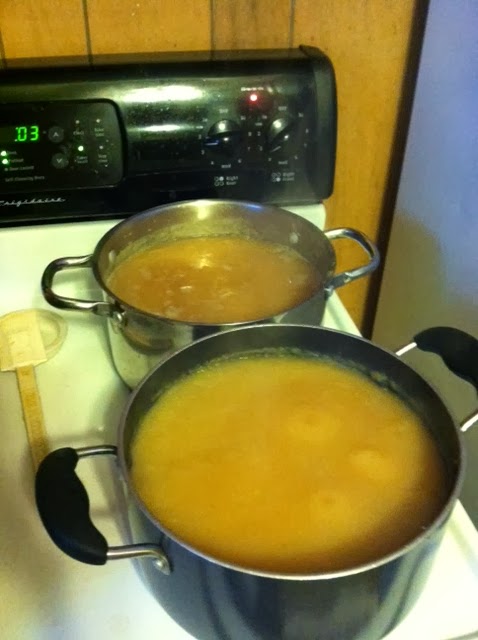
The apples we used were JonaGold. We made our apple-picking trip late this year, so there wasn't much of a choice in apple variety. That was fine with me. The apples still were delicious! We picked 60 pounds of apples this year, so we are in apple overload! We also picked about 60 pounds for my mom. She was busy that weekend, so we picked for her. I love going out to the orchard to pick the apples. Nothing is better than picking your own fruit and eating it right then and there. The warm fruit is beyond compare.
I also love dehydrated apples. The rest of my family isn't as keen on the idea, but as I type this, I'm snacking on some. They are almost addictive! I have a tiny plastic dehydrator that my mom bought several years ago. We don't use it much, but I dry herbs and apples with it. It's nice that it's so small, but a larger one would be nice, if I could just utilize it like it should be. Maybe one day. Two batches were made and I will probably leave it at that. They will most likely be gone by Christmas, but that will keep me wanting more for next year.

Between apple drying and sauce making, we finally got the wood put up from the front yard. Earlier this year we had to cut down the oak tree in our front yard. We think it got hit by lightning a couple years ago and each year the leaves fell off in early summer. Branches kept falling out when the wind blew and finally the bark at the base of the tree began to come off in large sheets. We knew it had to come down. In late September my husband took the chainsaw to it and made several cuts to make sure it fell the direction we wanted. We probably let it lay in the yard longer than we should have, but it was still warm and neither one of us really wanted to cut wood in the heat. Saturday was cool and there was no wind, so we decided to get it loaded up. The top branches were already dried, so we loaded them up and stacked them on the side of the house.

This pile will probably last a good 6-8 weeks heating our home. Not nearly enough to get through the winter, but a good start. We have another pile of seasoned wood out by the silo to burn too. Probably still not enough, but we have some other wood cutting sites that should get us stocked up.
The trunk of this big oak wasn't dry, so we cut it into large slices. Oh my, those were huge. It took three of us to roll them to the splitter and up our make shift risers to get it onto the splitting area. We ended up with a full trailer of wet wood to stack up for next year and there is still more in the front yard. Hopefully we can get it loaded this week and stacked up in it's new home.
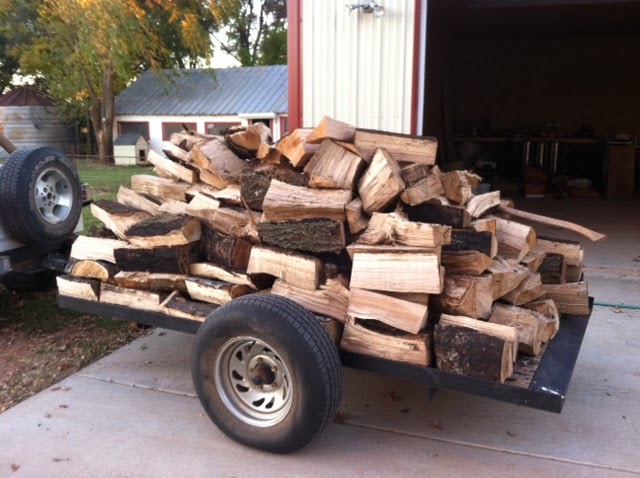
Our wood of choice to burn is hedge or mulberry. Oak is a nice dense wood too and should do a good job of heating the house. We are overrun with cottonwood and elm trees at our place, but we only burn those in the outdoor fire pit. They are not as dense, so they don't burn as hot and they leave a ton of ash behind. Hedge can be a tricky wood to burn though. It likes to spark. Our fireplace is completely closed up except for the small vent in the back, so not many sparks make it out. My husband said that a nearby city will not let you burn hedge because of the sparking hazard. Glad we live where we do so we can burn it!
What type of wood do you prefer to burn in your fireplace?
The apples we used were JonaGold. We made our apple-picking trip late this year, so there wasn't much of a choice in apple variety. That was fine with me. The apples still were delicious! We picked 60 pounds of apples this year, so we are in apple overload! We also picked about 60 pounds for my mom. She was busy that weekend, so we picked for her. I love going out to the orchard to pick the apples. Nothing is better than picking your own fruit and eating it right then and there. The warm fruit is beyond compare.
I also love dehydrated apples. The rest of my family isn't as keen on the idea, but as I type this, I'm snacking on some. They are almost addictive! I have a tiny plastic dehydrator that my mom bought several years ago. We don't use it much, but I dry herbs and apples with it. It's nice that it's so small, but a larger one would be nice, if I could just utilize it like it should be. Maybe one day. Two batches were made and I will probably leave it at that. They will most likely be gone by Christmas, but that will keep me wanting more for next year.
Between apple drying and sauce making, we finally got the wood put up from the front yard. Earlier this year we had to cut down the oak tree in our front yard. We think it got hit by lightning a couple years ago and each year the leaves fell off in early summer. Branches kept falling out when the wind blew and finally the bark at the base of the tree began to come off in large sheets. We knew it had to come down. In late September my husband took the chainsaw to it and made several cuts to make sure it fell the direction we wanted. We probably let it lay in the yard longer than we should have, but it was still warm and neither one of us really wanted to cut wood in the heat. Saturday was cool and there was no wind, so we decided to get it loaded up. The top branches were already dried, so we loaded them up and stacked them on the side of the house.
This pile will probably last a good 6-8 weeks heating our home. Not nearly enough to get through the winter, but a good start. We have another pile of seasoned wood out by the silo to burn too. Probably still not enough, but we have some other wood cutting sites that should get us stocked up.
The trunk of this big oak wasn't dry, so we cut it into large slices. Oh my, those were huge. It took three of us to roll them to the splitter and up our make shift risers to get it onto the splitting area. We ended up with a full trailer of wet wood to stack up for next year and there is still more in the front yard. Hopefully we can get it loaded this week and stacked up in it's new home.
Our wood of choice to burn is hedge or mulberry. Oak is a nice dense wood too and should do a good job of heating the house. We are overrun with cottonwood and elm trees at our place, but we only burn those in the outdoor fire pit. They are not as dense, so they don't burn as hot and they leave a ton of ash behind. Hedge can be a tricky wood to burn though. It likes to spark. Our fireplace is completely closed up except for the small vent in the back, so not many sparks make it out. My husband said that a nearby city will not let you burn hedge because of the sparking hazard. Glad we live where we do so we can burn it!
What type of wood do you prefer to burn in your fireplace?
Subscribe to:
Posts (Atom)